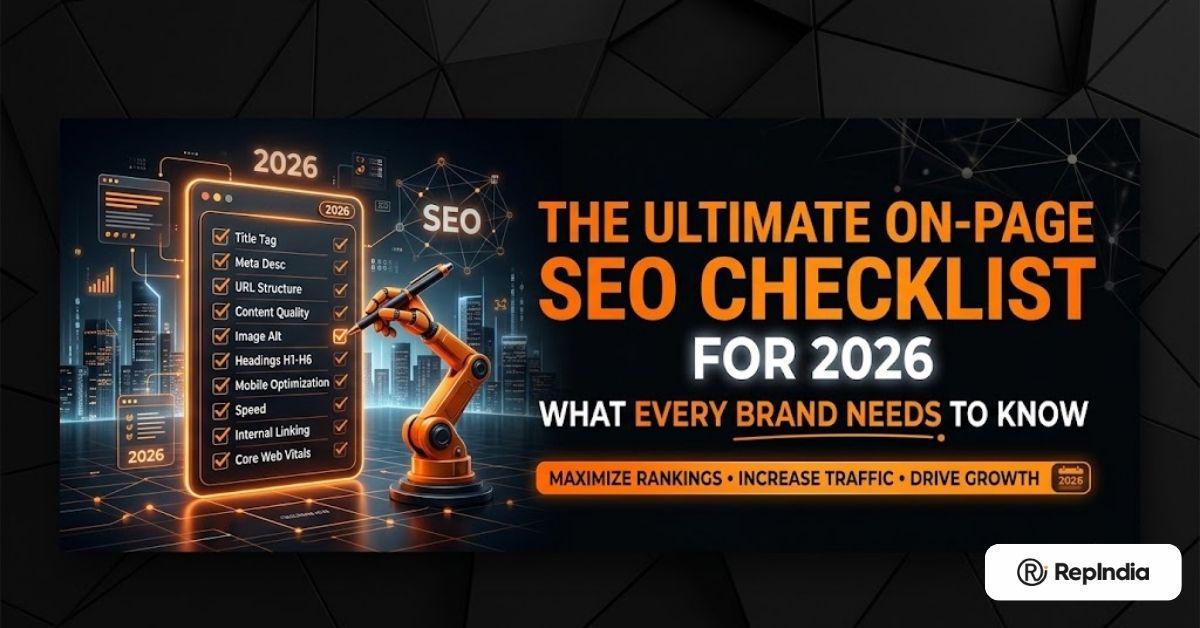
Search engines are smarter than ever. Google now evaluates not just what’s on your page, but how well it truly serves the person searching.
AI-powered tools like ChatGPT, Perplexity, and Google’s AI Overviews are also crawling and citing websites, creating a second discovery ecosystem your brand can’t afford to ignore.
This is your definitive on-page SEO checklist for 2026, no recycled tips, no vague generalisations. Just actionable steps that deliver real results.
On-page SEO refers to all optimisations made directly on a webpage to improve its search visibility — think content structure, keyword placement, meta tags, page speed, and internal linking.
In 2026, it matters more than ever because:
Before writing a single word, ask: is this query informational, navigational, or transactional? A user searching “on-page SEO checklist” wants to learn and apply.
A user searching “best SEO company in Delhi” is ready to hire. Serving the wrong intent — no matter how well-written the page — means poor rankings and high bounce rates.
Don’t optimise for one keyword in isolation. Pair your primary keyword with related phrases, synonyms, and questions your audience is actually asking.
For a page targeting “on-page SEO checklist 2026,” supporting terms include: title tag optimisation, meta description best practices, Core Web Vitals, schema markup, and internal linking strategy.
Your title tag is the first thing a searcher sees. Keep it under 60 characters, lead with your primary keyword, and make it benefit-driven — not clickbaity. Good: “On-Page SEO Checklist 2026: Best Practices That Matter”
Meta descriptions don’t directly impact rankings, but they significantly influence click-through rates. Write 150–160 characters that summarise the page’s core benefit and naturally include your target keyword. Set accurate expectations — no over-promising.
Use exactly one H1, aligned with your primary keyword and searcher’s intent. H2s should cover the major sub-questions a reader would ask; H3s break those down further. A clean heading structure helps both users skim and search engines understand your content hierarchy.
Google’s quality evaluators look for Experience, Expertise, Authoritativeness, and Trustworthiness. Generic, thinly-written content simply doesn’t rank in 2026.
Your content must offer original insight, complete answers, and a clear, readable style — short paragraphs, active voice, no padding.
Use your primary keyword in the title tag, H1, opening paragraph (within the first 100 words), at least one subheading, the meta description, and image alt text. Beyond these anchor placements, write naturally.
Keyword stuffing is not just ineffective — it actively harms your rankings.
AI tools and featured snippets pull from pages that answer questions directly and use structured formats — numbered lists, bullet points, definition-style paragraphs.
Write a concise 40–60-word answer to your page’s main question early in the content to maximise your chances of being cited.
Keep URLs short, descriptive, and hyphen-separated. Always include your primary keyword. Good: /on-page-seo-checklist-2026 | Avoid: /page1-tips-v3-final
Write descriptive, keyword-relevant alt text for every image. Compress files to WebP format for faster load times and use descriptive file names instead of generic ones like IMG_0034.jpg.
Structured data helps search engines understand your content and unlocks rich results — star ratings, FAQs, breadcrumbs. Use Article schema for blog posts, LocalBusiness for service pages, and FAQPage for FAQ sections.
Google’s performance benchmarks for 2026:
Audit regularly via Google Search Console and PageSpeed Insights.
Google indexes the mobile version of your site first. A page that loads slowly or breaks on a smartphone loses both rankings and potential customers. Test every important page using Google’s Mobile-Friendly Test.
Every page should link to 2–5 relevant pages on your site using descriptive anchor text — never vague phrases like “click here.” Internal links distribute authority across your site and guide users naturally toward conversion.
Stale content steadily loses rankings. Revisit high-value pages regularly — update statistics, fix broken links, expand thin sections, and add internal links to newly published content. Freshness is a signal Google rewards consistently.
|
Element |
Best Practice |
|
Title Tag |
Under 60 characters, keyword-first |
| Meta Description |
150–160 characters, benefit-driven |
|
H1 |
One per page, matches search intent |
| Subheadings |
Logical H2/H3 structure |
|
Content |
E-E-A-T, original insight, no padding |
| URL Slug |
Short, descriptive, hyphen-separated |
|
Images |
Alt text + WebP compression |
|
Schema Markup |
Article / LocalBusiness / FAQPage |
|
Core Web Vitals |
LCP < 2.5s, INP < 200ms, CLS < 0.1 |
| Internal Links |
2–5 per page, descriptive anchors |
| Content Freshness |
Audit every 3–6 months |
Write a Message