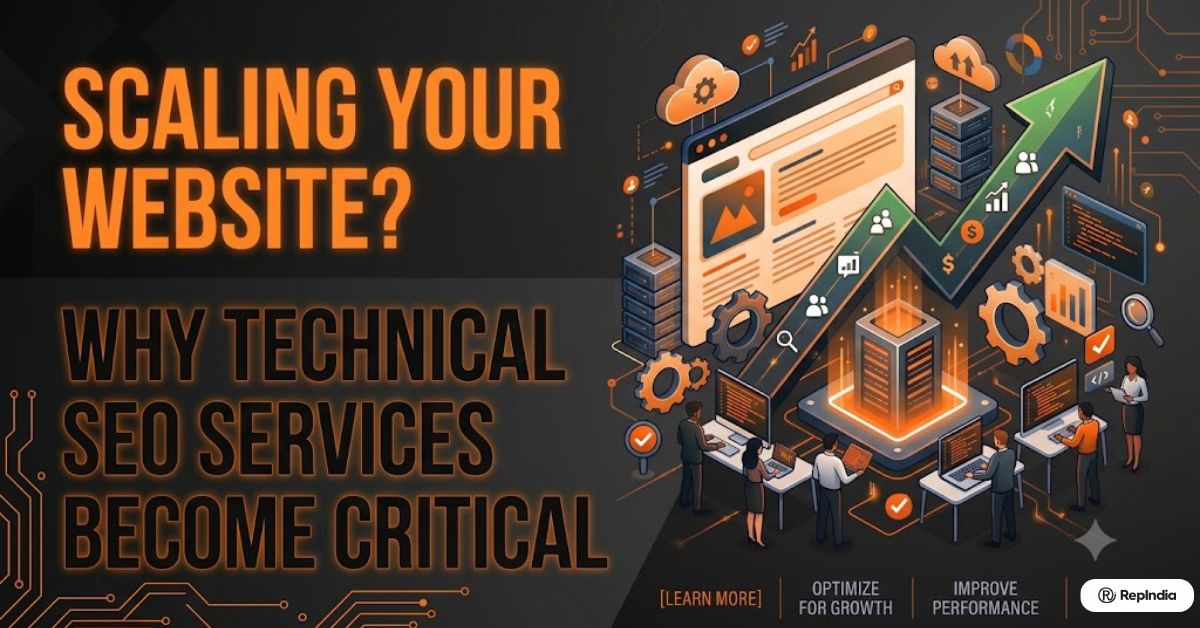
Growth feels rewarding until things begin to slow down, where it matters most. Traffic increases, new pages go live, campaigns expand, and suddenly, a website that once performed smoothly starts showing cracks.
Pages take longer to load, rankings shift unpredictably, and conversions stop matching the traffic coming in. What changed?
We, at RepIndia, have consistently seen this pattern across scaling websites, where performance issues surface only after expansion begins.
What appears to be steady digital growth often exposes underlying gaps in structure, speed, and crawl efficiency.
User expectations in 2026 are far less forgiving. Speed, accessibility, and seamless navigation now decide whether a visitor stays or leaves within seconds.
Search engines evaluate websites through the same lens. A site is measured by how efficiently it delivers information and how easily it can be accessed.
A 2026 performance study highlights a clear pattern: a 3-second page load delay can increase bounce rates by over 30%, directly impacting engagement and rankings.
Scaling a website changes how it behaves.
Pages multiply, sections expand, and new content layers get added across different categories. What starts as a controlled structure slowly turns complex.
At this stage, patterns begin to appear:
The issue shifts from content creation to how well the system holds everything together.
At scale, both search engines and users depend heavily on structure and efficiency to navigate a website.
Search engines rely on signals such as crawl paths, internal linking, page speed, and hierarchy to determine what to index and rank. When these signals are unclear, important pages lose priority.
Users behave differently. A delay of even a few seconds, or a broken navigation flow, creates friction that immediately affects trust and engagement.
Technical SEO services become critical because they stabilise three core areas that directly influence growth:
Search engines require a clear structure to identify priority pages. Without it, rankings fluctuate, and key pages fail to gain traction.
Speed, mobile responsiveness, and server behaviour shape how users experience the website during high traffic.
A scalable system allows new pages and sections to be integrated without affecting existing performance.
When these elements are misaligned, growth introduces instability rather than progress.
Technical SEO focuses on the infrastructure of a website. It ensures search engines can access, understand, and process content efficiently while users navigate without friction.
Content attracts attention, but technical structure determines how smoothly that attention is handled.
Core components include the following:
Each component becomes more significant as website size increases.
A small website behaves differently from a large one.
As pages increase, structural challenges begin to surface:
Search engines prioritise clarity. When structure becomes unclear, ranking signals weaken.
More content does not guarantee stronger rankings. Search engines prioritise efficiency and usability.
One of the strongest indicators of performance issues is bounce behaviour. A bounce occurs when users leave a page without interacting further, and this rate increases when pages load slowly or feel difficult to navigate.
Another key factor is crawl budget. Search engines allocate limited resources to scan a website. Large sites often waste this capacity on low-value or repetitive pages, reducing visibility for priority content.
A structured approach helps maintain consistency during expansion. A technical SEO checklist for 2026 typically guides this process.
Key elements include:
Each element contributes to long-term stability during growth.
Search engines prioritise websites that are fast, structured, and easy to interpret.
Clear architecture improves indexing accuracy, faster performance improves engagement, and secure browsing signals improve trust.
Search performance is also influenced by the competitiveness of a digital market, which varies across regions. In larger metropolitan markets, search demand is higher, competition is more intense, and ranking shifts occur more frequently than in smaller cities.
For example, performance challenges in cities like Mumbai or Bengaluru often stem from dense competition across similar service categories, where even small technical improvements can impact visibility.
Within this context, a business working with an experienced SEO company in Delhi often sees noticeable improvements in visibility once structural issues are resolved, especially in environments where multiple brands compete aggressively for the same search space and technical precision becomes a key ranking differentiator.
Technical structure directly shapes user experience. When pages load slowly, engagement naturally drops because users are less likely to wait for content to appear.
Poor navigation further disrupts the journey by making it harder for visitors to find relevant sections, which often leads to drop-offs before meaningful interactions occur.
Improvements in these areas typically lead to better engagement rates as users interact more comfortably with a website that loads faster and functions smoothly.
This also results in longer session durations, as visitors tend to stay and explore when navigation feels seamless and content is easy to access.
Over time, these improvements contribute to improved conversion outcomes, since users are more likely to take meaningful actions on a website that performs reliably and delivers a consistent experience.
A smoother experience encourages deeper interaction with the website.
Certain signals often indicate underlying structural issues within a website. A rise in traffic that does not lead to a proportional increase in conversions usually suggests that users are not finding what they expect.
Pages may also be indexed by search engines but still fail to rank, indicating weak relevance or poor optimisation signals. In some cases, site speed begins to decline after content scaling, affecting both user experience and visibility.
Crawl errors appearing in reports further highlight difficulties search engines have accessing and interpreting the website. When these signals are ignored, performance issues tend to build up gradually and become harder to resolve over time.
Technical challenges require systematic resolution rather than isolated fixes.
A structured process includes:
We focus on building scalable technical systems that support long-term growth while maintaining stability across all performance layers.
A growing website needs a structure that supports expansion without performance degradation.
Technical SEO strengthens that structure by improving speed, clarity, and search accessibility in a coordinated way.
Scaling a website and noticing performance gaps signals the right moment to act. Connect with us at RepIndia to strengthen technical foundations and build a system designed for consistent, scalable growth.
FAQs:
Write a Message