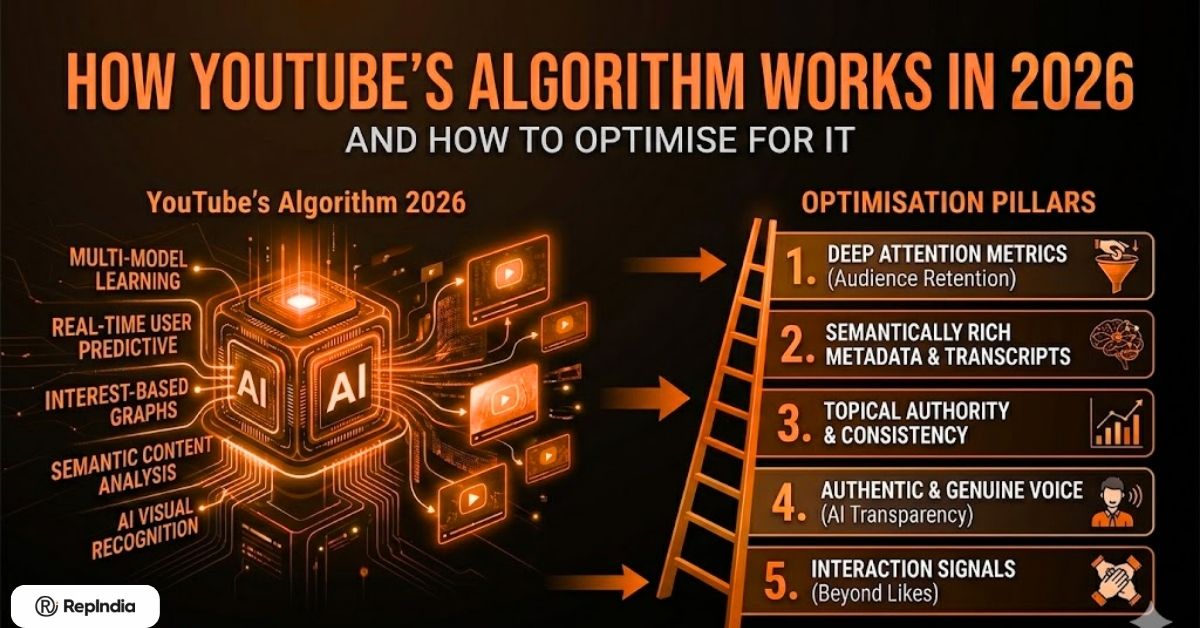
YouTube in 2026 runs on a far more intelligent recommendation system than creators saw a few years ago. The platform now studies viewer behaviour, content relevance, viewing patterns and satisfaction signals with greater precision.
Strong production quality still matters, though creators who understand audience intent are seeing stronger growth than channels chasing vanity metrics.
We, at RepIndia, have seen brands shift their video strategies dramatically over the past year. Search visibility, viewer retention and audience consistency now influence content performance far more deeply than upload frequency alone.
Creators and businesses aiming to grow on YouTube need to understand how the platform currently distributes content and what actually drives visibility.
The platform now operates multiple recommendation systems across:
Each section evaluates content differently. Search prioritises relevance and intent. Suggested videos rely heavily on viewing behaviour and topic association. Shorts focuses on replay value and completion rates.
This means creators cannot depend on one optimisation tactic across every content format.
The biggest shift in 2026 revolves around satisfaction-based ranking.
YouTube now measures:
The platform increasingly rewards videos that leave viewers feeling satisfied after watching. Several industry studies and creator analyses suggest that shorter videos delivering strong value can outperform longer videos with higher raw watch time.
This has changed how brands approach content strategy.
A tightly edited six-minute tutorial that solves a problem effectively often performs better than a twenty-minute video filled with filler content.
Audience retention remains one of the strongest performance indicators on YouTube.
The first 30 seconds now carry significant weight because the platform uses early viewing behaviour to predict long-term performance. Videos losing viewers too quickly often struggle to gain wider distribution.
Strong creators are now focusing on:
Long introductions continue to hurt retention across both Shorts and long-form content.
Many successful creators now start videos directly at the core insight or problem statement instead of spending time on branding intros.
Thumbnails and titles continue to influence video distribution heavily.
YouTube first tests videos with small audience groups. A strong click-through rate signals relevance and interest. Poor CTR often limits broader exposure.
In 2026, strong thumbnails tend to follow a few clear principles:
Titles perform better when they communicate a specific outcome instead of vague curiosity.
Creators using misleading thumbnails may gain temporary clicks, though weak viewer satisfaction eventually reduces visibility.
YouTube now understands video content beyond metadata alone.
The platform analyses:
Advanced AI systems now help YouTube understand content themes at a deeper level. This has reduced the importance of keyword stuffing and repetitive tagging.
Modern video optimisation depends more on topic clarity and audience relevance.
That is why YouTube video SEO 2026 focuses heavily on semantic relevance rather than isolated keyword placement.
YouTube Shorts has evolved into its own ecosystem.
The Shorts feed prioritises:
Traditional CTR matters far less inside Shorts.
Short-form creators now focus heavily on:
Many brands use Shorts to test content concepts before expanding them into long-form videos.
One major change in 2026 is YouTube’s audience classification system.
The platform now places strong emphasis on matching content with the right audience instead of pushing videos broadly across unrelated viewers. Discussions within creator communities strongly support this shift towards audience-focused distribution.
Channels posting inconsistent topics often confuse the recommendation system.
Creators building clear niche authority are seeing stronger growth because YouTube understands exactly who should receive their content.
This is where a structured content strategy becomes important. A focused content ecosystem consistently outperforms random viral experiments.
Recommendations drive most YouTube traffic, though search remains highly valuable for long-term discovery.
Videos ranking well in search can continue generating traffic for months or even years. Discussions across SEO communities highlight how retention and satisfaction now work alongside traditional keyword relevance.
Effective optimisation now includes:
Brands investing in the best video SEO 2026 strategies are focusing on content depth and audience intent rather than aggressive keyword repetition.
At RepIndia, we often advise clients to treat YouTube like a long-term search platform rather than a short-term viral engine.
Subscriber count alone no longer guarantees reach.
Returning viewers now provide one of the strongest signals of audience trust and content quality. Channels generating repeat engagement tend to receive stronger recommendation support from the platform.
This has pushed creators towards building:
A connected content strategy keeps viewers inside a creator’s ecosystem longer, which supports stronger session performance.
Businesses searching for a reliable SEO company in Delhi are increasingly prioritising YouTube visibility alongside traditional search optimisation because video discovery now influences consumer trust across multiple digital touchpoints.
Similarly, brands investing in SEO services in Mumbai are integrating video SEO into broader digital campaigns as YouTube continues strengthening its position as both a search engine and content platform.
YouTube in 2026 rewards brands that understand audience behaviour, search intent and content performance at a deeper level. A strong strategy can improve discoverability, retention and long-term engagement across both Shorts and long-form content.
Our team helps brands create data-backed video strategies designed for measurable growth. From content planning and audience research to YouTube SEO and performance optimisation, our team works closely with brands to build visibility that lasts.
Explore how RepIndia can help your brand grow on YouTube with smarter content and a stronger digital strategy.
YouTube’s algorithm analyses viewer behaviour, retention, engagement, satisfaction signals and content relevance to recommend videos across Search, Home feed, Suggested videos and Shorts.
Yes, watch time remains important, though viewer satisfaction and retention now play a much bigger role in long-term video performance.
YouTube SEO remains essential for discoverability. Strong titles, accurate descriptions, captions, chapters and topic relevance help videos rank better in search and recommendations.
Yes, Shorts can increase reach, attract new audiences and improve discoverability when paired with a consistent long-form content strategy.
Content with strong hooks, clear storytelling, audience relevance and high viewer retention tends to perform best across both Shorts and long-form formats.
Write a Message