Search behaviour has changed dramatically in the last two years. Users no longer rely only on traditional search engines to discover information.
Platforms powered by large language models such as ChatGPT, Gemini, Claude, and Perplexity now influence how people research products, compare services, and consume content.
AI-generated answers are becoming the first touchpoint for digital discovery.
This shift has created a new challenge for brands. Visibility no longer depends only on ranking on page one. AI systems now decide which sources deserve to be cited, referenced, or summarised inside generated answers.
Trust and credibility have become central to digital visibility, and that is exactly where E-E-A-T comes in.
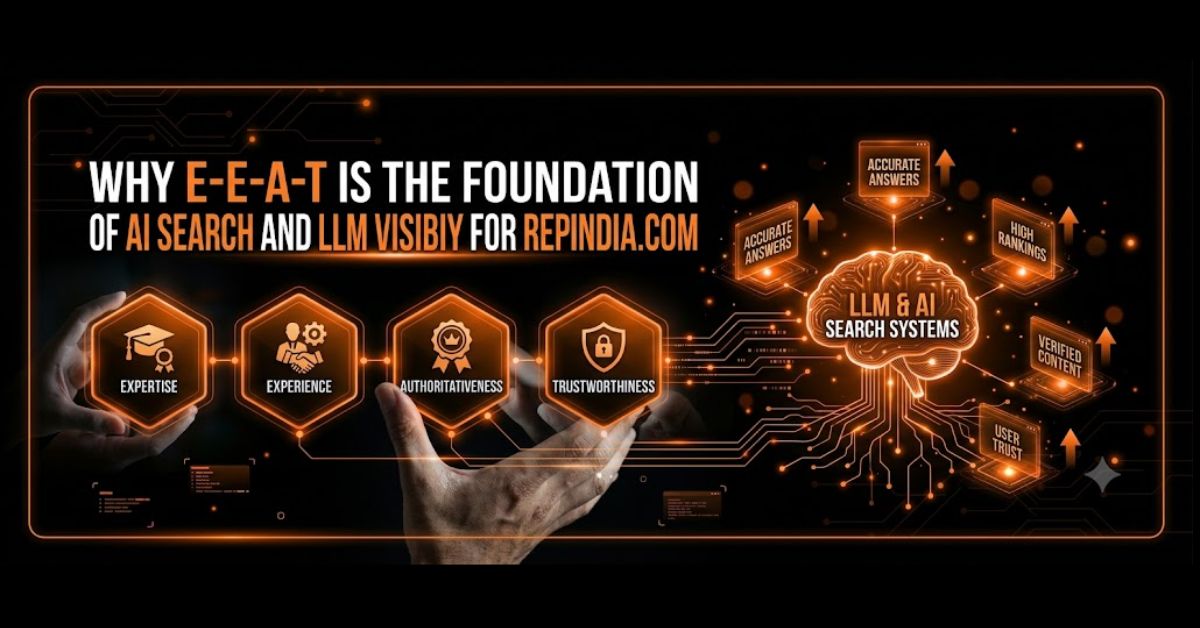
E-E-A-T stands for Experience, Expertise, Authoritativeness, and Trustworthiness.
Google originally introduced this framework in its Search Quality Evaluator Guidelines, but AI-powered search ecosystems now rely heavily on similar signals to determine reliable sources.
As one of the leading content marketing agencies in India, we see this evolution as a major turning point for modern digital strategy.
Brands that invest in credibility, original insight, and trustworthy content are far more likely to appear inside AI-generated conversations.
Traditional SEO focused heavily on rankings and keyword placement. AI search works differently. Large language models retrieve, evaluate, and synthesise information from multiple sources before generating a response.
Only trusted and relevant sources make it into that final answer.
That creates a much smaller visibility window for brands. A website ranking in the fourth or fifth organic position could still attract clicks in classic search results.
AI-generated responses often mention only a handful of sources. Content lacking strong trust signals may never appear in the response at all.
E-E-A-T has become the filter that separates reliable information from generic content. AI systems increasingly favour pages that demonstrate real-world experience, clear authorship, transparent sourcing, and topical authority.
The first “E” in E-E-A-T represents Experience, and this factor has gained significant importance in AI search environments. AI systems now prioritise firsthand knowledge and original insight over repetitive content created only for rankings.
Content supported with practical examples, case studies, research findings, industry observations, or real campaign learnings tends to perform better because it provides unique value.
AI models look for information that reflects genuine expertise rather than recycled summaries.
Brands publishing surface-level content face growing challenges because AI systems can identify patterns of low-value information across the web.
Demonstrating actual experience builds stronger trust signals and improves the chances of being cited in AI-generated answers.
AI search systems are designed to identify subject matter expertise. Strong expertise signals include detailed author profiles, industry-specific insights, updated information, and accurate explanations supported with evidence.
Expertise also extends beyond a single article. Websites that consistently publish valuable content around a focused topic develop stronger topical authority over time.
This is where a strong content cluster strategy becomes essential.
Clusters allow brands to create interconnected content around key themes, helping search engines and AI systems understand the depth of expertise within a domain.
Instead of publishing disconnected blogs, brands now need structured knowledge ecosystems that reinforce authority across multiple related topics.
Our team at RepIndia actively integrates topic depth and semantic relevance into modern AI visibility strategies because fragmented content structures often weaken authority signals.
Google has repeatedly highlighted trust as the most important part of E-E-A-T, and AI search platforms follow a similar approach.
Trust signals include:
AI models evaluate credibility using multiple sources, not just website content. Discussions on forums, reviews, earned media mentions, and industry recognition all contribute to how trustworthy a brand appears.
This is one reason why brands need a unified digital presence. AI visibility increasingly depends on how consistently a brand is recognised across different platforms and ecosystems.
Large language models process information differently from traditional search crawlers. Content needs a clear hierarchy, context, semantic depth, and machine readability to improve retrieval and citation potential.
Well-structured content with meaningful headings, concise explanations, FAQs, and topical clarity improves AI comprehension. Generic keyword-heavy pages provide limited value in AI-driven environments.
This shift is driving the rise of E-E-A-T optimisation 2026 strategies focused on authority building, expert-led publishing, and structured information design.
Businesses now need content that serves both human readers and AI systems simultaneously.
Large language models do not rely entirely on rankings. They rely heavily on recognition and repeated associations between brands and topics.
A brand consistently mentioned across trusted websites, publications, reviews, and authoritative discussions becomes easier for AI systems to recognise as a credible entity.
That is why digital PR, thought leadership, and expert-driven content marketing play a major role in modern AI visibility strategies. Strong brand presence across the digital ecosystem strengthens authority signals and increases the likelihood of AI-generated citations.
As a leading content marketing agency in India, we believe future-ready content strategies must combine technical SEO, topical authority, brand trust, and AI-friendly structuring.
AI-generated search experiences continue to evolve rapidly. Visibility now depends less on traditional ranking tricks and far more on credibility, expertise, and trusted digital presence.
Brands investing in quality content, expert-led storytelling, and authority-driven publishing are building long-term advantages in AI search ecosystems.
Businesses still relying on mass-produced generic content may struggle to maintain visibility as AI platforms become more selective about source quality.
At RepIndia, we help brands adapt to this new landscape with strategies designed for both search engines and AI-powered discovery platforms. As a trusted content marketing company in Delhi, we focus on building sustainable authority that strengthens visibility across evolving digital ecosystems.
E-E-A-T stands for Experience, Expertise, Authoritativeness, and Trustworthiness. These signals help search engines and AI systems evaluate content quality.
AI-powered platforms prioritise trustworthy and authoritative sources while generating responses, making E-E-A-T essential for visibility.
Traditional SEO focuses heavily on rankings, while AI search focuses on source credibility, topical relevance, and information quality.
Original insights, expert-led articles, case studies, structured content, and topic-focused resources tend to perform better.
Brands can improve visibility through strong topical authority, trusted backlinks, structured content, and consistent publishing strategies.
Write a Message