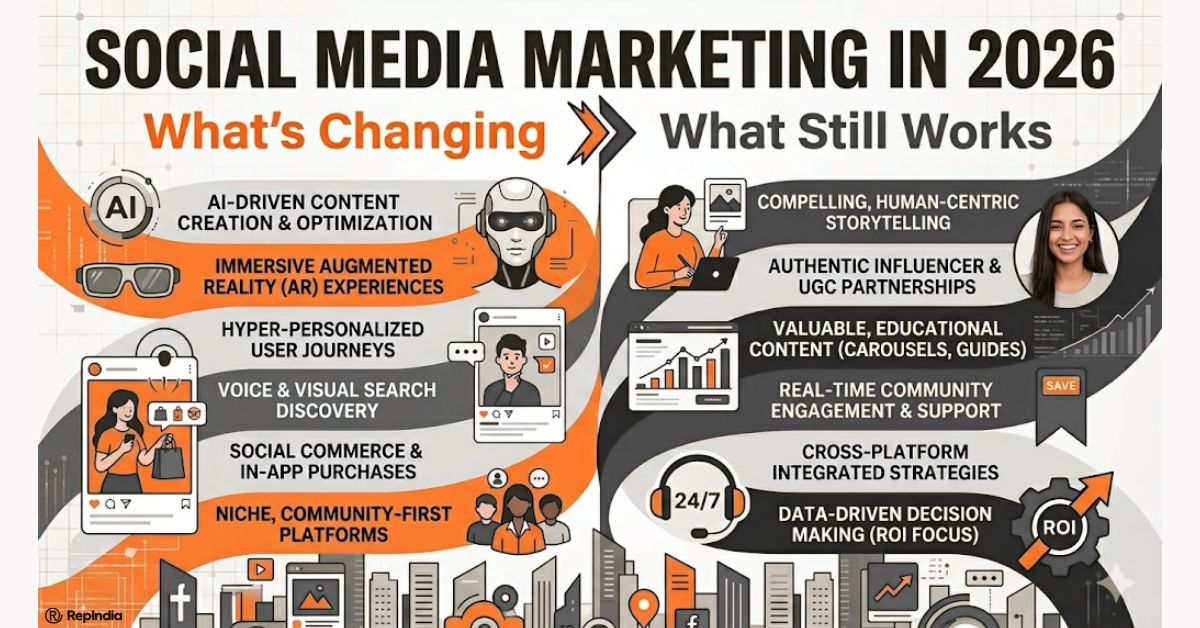
Social media in 2026 looks louder on the surface and sharper underneath. Platforms continue to evolve at speed, attention spans feel tighter, and AI sits at the centre of every serious conversation.
Yet the fundamentals that build trust, relevance, and long-term brand value remain familiar. Growth now depends on understanding what has genuinely shifted and what still deserves steady focus.
At RepIndia, our work across industries shows a clear pattern. Brands that adapt with intent are moving ahead, while those chasing every new feature are losing clarity.
AI has moved from support to strategy. Content creation, scheduling, performance analysis, social listening, and customer responses are increasingly powered by intelligent systems.
A strong social media marketing ai strategy for 2026 focuses on speed, scale, and accuracy without flattening brand voice. AI now predicts what content will perform, when it should be published, and how audiences are likely to react.
Platforms have also become discovery engines. Search behaviour has shifted towards Instagram, LinkedIn, YouTube, and emerging short-video platforms.
Users look for recommendations, reviews, and explanations inside social feeds instead of traditional search engines. Content structure matters more than volume. Clear hooks, descriptive captions, and keyword-rich visuals now influence reach.
Paid and organic boundaries continue to blur. Organic content drives credibility while paid media ensures consistency and scale. Strategy ties the two together instead of treating them as separate efforts.
Brands investing in a clear social media marketing strategy for the 2026 plan, content and media together from the start.
Private engagement is rising. Broadcast reach still matters, yet real loyalty is built through DMs, close groups, comment sections, and community formats.
Audiences expect responses that feel timely and human. Automation supports this shift, but oversight keeps it grounded.
Strong storytelling remains central. Audiences still connect with clarity, honesty, and relevance. Stories about people, progress, values, and outcomes outperform generic trends. Simple language builds familiarity. Over-designed content often creates distance.
Consistency continues to win. Brands that show up regularly with a recognisable tone stay top of mind. Irregular posting and reactive content dilute impact. Scheduling tools help, yet discipline makes the difference.
Trust remains fragile. Transparency, accuracy, and respectful communication hold weight. Inflated claims and forced humour create quick disengagement. Social platforms amplify both credibility and mistakes at the same speed.
Data still guides decisions. Metrics such as saves, shares, comments, and completion rates offer deeper insight than surface engagement. Teams that review performance weekly adapt faster and waste fewer resources.
AI works best as an assistant. It accelerates research, highlights patterns, and reduces repetitive tasks. It does not replace judgment. Human input shapes context, tone, and ethical boundaries.
The brands seeing sustained growth use AI to free time for thinking, planning, and refining ideas.
A practical social media marketing ai strategy for 2026 defines where automation starts and where it stops. Content outlines, first drafts, and performance predictions benefit from AI. Final messaging, cultural sensitivity, and crisis responses require human control.
Regional relevance has gained importance. Audiences respond better to brands that understand local behaviour, language nuances, and platform preferences. For example, when a business looks for a social media agency in Bangalore, the expectation goes beyond basic execution.
There is a clear need for insight into a competitive market, tech-driven audiences, and fast-moving digital habits that shape how people engage online.
An agency that understands the city brings this context into everyday decisions. Posting times reflect real usage patterns. Creative references feel familiar rather than generic. Influencer choices align with local credibility.
Community management feels timely and culturally aware. This local understanding helps national brand goals land more effectively on the ground.
Clarity continues to matter more than complexity. Effective strategies are shaped by a clear understanding of who the brand is speaking to, why the message holds value, and what action the content is meant to drive.
When this direction is defined, content feels purposeful instead of scattered.
Stronger results also come from closer collaboration between creative, media, and analytics teams, as shared insights lead to faster responses and better decision-making.
Testing remains essential, with small experiments helping teams learn what works before scaling, while AI supports the process by identifying patterns that still require human judgment.
Brands grow when purpose leads the use of tools rather than the other way around.
As social media continues to evolve, the brands that stand out will be the ones that stay focused, respect attention, and use technology with intent.
Our team at RepIndia can help you build a social presence that feels clear, consistent, and ready for what comes next, with a strategy that supports meaningful and sustainable growth.
Write a Message