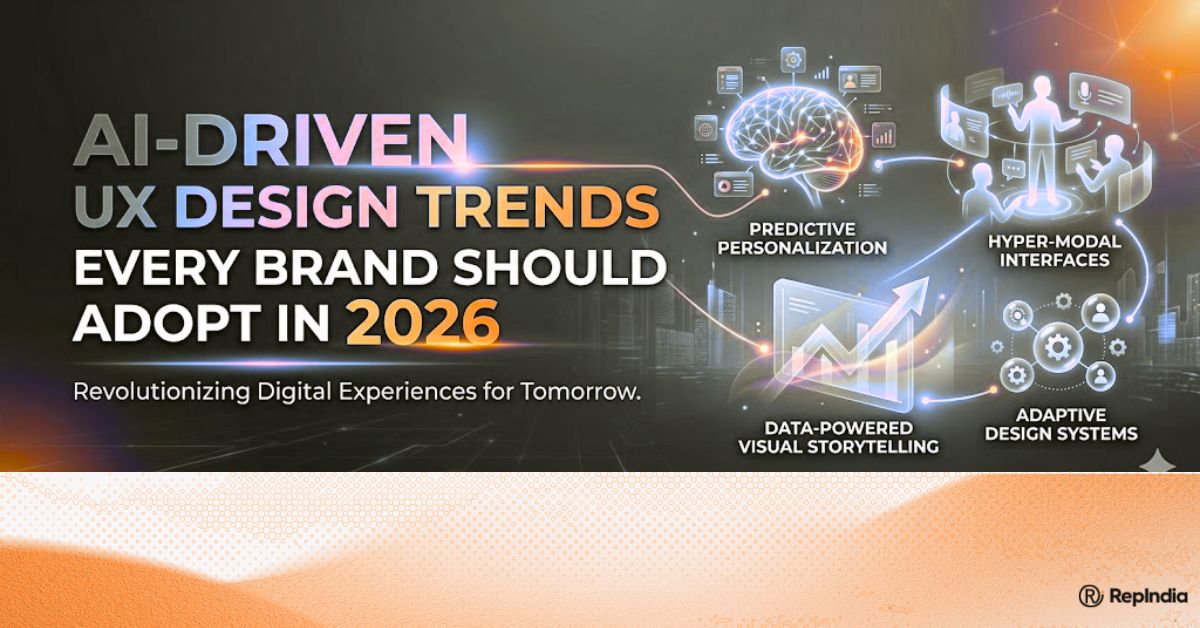
In 2026, digital experiences are evolving fast. The way users interact with products online has shifted dramatically, not just because of aesthetic preferences but due to big behavioural and technological changes.
At RepIndia, we’ve been at the forefront of blending creativity with meaningful user experiences, and that’s made us realise this transition isn’t about flashy effects, it’s about intelligent, responsive design that feels effortless, human-centred, and purposeful.
In this detailed guide, we walk through AI-driven UX design trends every brand should adopt in 2026. Many of these trends are deeply influencing the broader web design trends & ideas 2026 conversation and are powered by advances in artificial intelligence and machine learning.
One of the most significant shifts for user experience in 2026 is real-time personalisation. AI-driven UX systems can analyse user behaviour, intent, and context, such as time of day, location, device type, and past interactions, to tailor interfaces dynamically.
This means content, layout, and calls to action are no longer static but adapt to each user’s journey.
For brands, this level of responsiveness helps improve engagement, increase conversion rates, and reduce churn. It also supports inclusive design, as interfaces can adjust to user preferences like larger text or simplified layouts without manual tuning.
Natural language interaction is now a core part of UX design. AI-powered conversational interfaces that support voice and text interactions are increasingly replacing traditional menus and forms, especially on complex platforms.
These systems allow users to converse with websites and apps, ask questions, complete tasks, and navigate experiences more intuitively. For example, a user could ask a product site for “eco-friendly options under £100” and receive tailored suggestions instantly.
For businesses investing in digital experiences, this trend aligns with broader UX expectations where ease of use equals greater conversion and loyalty.
Traditional UX improvements relied heavily on manual testing, A/B tests, surveys, and analytics. In 2026, AI is taking optimisation to a new level through autonomous evaluation and iteration.
Machine learning systems now analyse usage patterns, detect friction points, and optimise interfaces without human intervention. These changes might involve altering page layouts, prioritising elements that drive engagement, or adjusting micro-interactions to reduce cognitive load.
This shift not only enhances performance but also frees up designers to focus on strategic work rather than repetitive tweaks.
Another major trend involves AI-generated UI components and layout systems. With generative design engines, it’s possible to produce brand-consistent visual elements from buttons to icons based on design principles and intent.
These systems ensure consistency while allowing designers to explore more creative directions. For example, AI can generate alternative layout variations that adhere to accessibility guidelines or brand rules, speeding up workflows and maintaining quality.
This capability is especially relevant when crafting responsive experiences that work across devices and contexts.
Subtle motion and micro-interactions are playing an increasingly important role in 2026 UX. These tiny animations help communicate state changes, guide attention and provide feedback all without overwhelming the user.
Smart motion not only improves usability but also enhances emotional connection and perceived performance. For example, a button that gently animates on hover gives immediate feedback, signalling to a user that an action is recognised and progressing.
Even minimal designers are thinking about motion as a functional tool rather than decorative flair.
Accessibility has become foundational to good UX design. Now, AI tools are helping make this easier by automatically detecting accessibility barriers and suggesting fixes, such as improving colour contrast or enabling keyboard navigation.
These practices aren’t merely compliance checkboxes. They expand your audience and reflect thoughtful design. When interfaces respect a user’s needs and abilities, trust and satisfaction increase, a win for any brand’s long-term growth.
Hyper-personalised UX where layout, content and even tone adapt to the individual is an emerging standard. But this level of customisation must be paired with clear controls and transparent data use practices.
AI systems are now capable of preserving privacy through techniques like federated learning and edge computing, which allow personalisation without centralising sensitive data. Users can control how much personalisation they want, balancing convenience with privacy.
Designers and brands that embrace this principle gain a competitive edge without sacrificing trust.
The future interface isn’t limited to clicks and taps. In 2026, voice and gesture interactions have become more integrated into web experiences, especially on mobile, wearable, and emerging AR/VR platforms.
These multimodal experiences help make interfaces feel natural and accessible, bridging gaps between physical and digital interactions.
The future of UX is intelligent, adaptive, and deeply human. While pure visuals still matter, the real shift lies in systems that understand, anticipate, and support users in meaningful ways.
These AI-driven UX design trends are shaping the most engaging and effective digital experiences in 2026, and they should be part of every brand’s strategic roadmap.
As one of the best web design companies in India, we at RepIndia are constantly learning, testing, and applying these principles in our work. Our focus is on creating digital experiences that resonate, perform, and deliver real business impact, not just look good.
We believe that embracing these AI-powered UX approaches will help brands connect with users more deeply, build trust, and stand out in an increasingly intelligent digital landscape.
FAQs
Write a Message