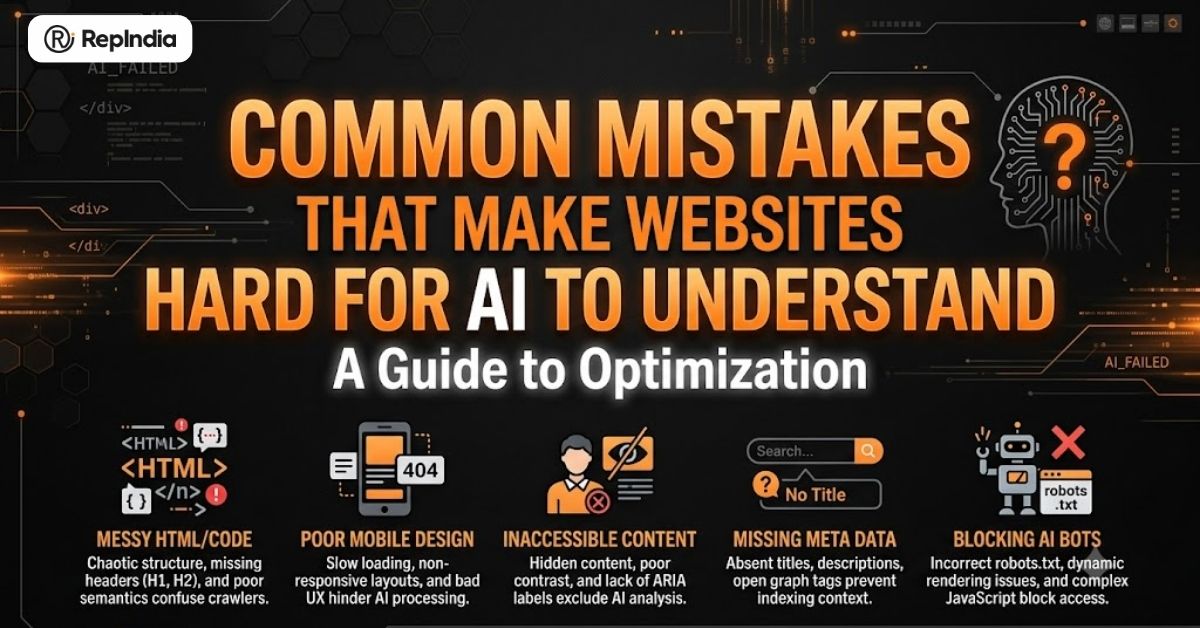
AI is changing the way people discover websites. Search engines no longer rely only on keywords and backlinks to decide which pages deserve visibility.
Modern AI systems analyse structure, context, intent, and clarity before surfacing content in search results, summaries, and recommendations.
Many brands still build websites with a human-first mindset while ignoring how machines interpret information. That gap creates major visibility issues. A website may look visually polished and still fail to communicate properly with AI systems.
Our team at RepIndia has seen businesses invest heavily in design and performance while overlooking the technical and structural elements that improve AI comprehension.
An AI-readable website helps search engines and AI models understand content accurately, making it easier to appear in AI-driven search experiences.
Here are some of the most common mistakes that make websites difficult for AI to process.
AI depends heavily on structure to understand hierarchy and meaning. Poor formatting creates confusion, especially when pages jump between topics without a clear flow.
Many websites use random heading placements, oversized text instead of proper H1 tags, or inconsistent section organisation. AI crawlers struggle to identify the main topic when content lacks logical sequencing.
Clear headings, organised sections, and topic-focused pages make interpretation easier for both users and search systems.
Simple improvements include:
Structured content improves readability and increases the chances of appearing in AI-generated responses.
Modern websites often rely heavily on JavaScript frameworks for dynamic experiences. While this may improve visual interactions, it can create accessibility issues for AI crawlers.
Important content hidden behind scripts, tabs, or delayed rendering often remains invisible during crawling. AI systems may access incomplete pages with missing information.
This issue commonly appears on:
Server-side rendering and properly rendered HTML help AI process information without interruptions.
Brands aiming to build the best AI-readable website should prioritise accessibility alongside design innovation.
AI systems prefer clarity over promotional language. Many websites still rely on broad statements that sound impressive but communicate very little.
Phrases such as:
Do not explain what a business actually offers.
Specificity matters. AI models need direct signals to categorise expertise and intent accurately.
Strong website copy explains:
Clear messaging also improves trust and user engagement.
Structured data acts as a translator between websites and AI systems. Schema markup provides context around products, services, FAQs, reviews, articles, and businesses.
Many websites either skip structured data entirely or implement it incorrectly. That creates uncertainty during interpretation.
Common problems include:
Search engines and AI assistants rely on structured information to generate accurate summaries and recommendations.
Proper schema implementation strengthens contextual understanding and improves discoverability.
Internal links help AI understand relationships between pages. Weak linking structures make websites appear disconnected and fragmented.
Pages without contextual links often lose authority because AI systems cannot determine how topics connect.
Problems usually include:
Logical internal linking creates stronger topic clusters and improves crawl efficiency.
We often recommend building content ecosystems instead of isolated pages. Connected information improves both usability and AI comprehension.
Critical content frequently sits inside accordions, expandable sections, or pop-ups. Humans may still interact with that information, but AI crawlers can miss it entirely.
Pricing details, service explanations, FAQs, and product specifications should remain easily accessible in the page source.
Visible content helps AI systems gather a complete contextual understanding without relying on user interaction.
Information architecture plays a bigger role than many businesses realise.
AI systems look for consistency. Multiple pages targeting the same topic with slight variations often reduce confidence.
This problem appears in:
Conflicting information also creates trust issues.
One page mentioning different pricing, services, or positioning from another page makes interpretation difficult.
Consolidated and clearly differentiated pages perform far better in AI-driven environments.
A strong content strategy prevents duplication while improving topical authority.
AI systems process entities instead of isolated keywords. Businesses that fail to establish clear identity signals often struggle with visibility.
Websites should clearly communicate:
Consistent branding across pages helps AI establish stronger associations.
A reliable website development company in Bangalore or a skilled web development company in Delhi should understand how entity optimisation contributes to long-term search visibility.
Accessibility improvements often benefit AI interpretation as well. Missing alt text, unclear navigation, and poor semantic HTML reduce readability for both machines and users.
AI systems increasingly process multimodal content, including images and videos. Missing context limits understanding.
Important accessibility improvements include:
Accessible websites usually perform better across search environments.
Slow-loading websites create crawl inefficiencies. AI systems work with limited crawl budgets, which means delayed pages may not get processed fully.
Large image files, unnecessary scripts, bloated code, and excessive redirects all contribute to poor performance.
Fast websites improve:
Technical optimisation remains essential even as AI reshapes digital discovery.
AI-driven search is evolving quickly, and websites that communicate clearly with machines will have a stronger advantage in visibility, discoverability, and user engagement. Small structural improvements today can create long-term gains in how your brand appears across search engines and AI-powered platforms.
At RepIndia, we help brands build future-ready digital experiences that combine performance, usability, and AI optimisation. If your website needs a stronger structure, better discoverability, or improved technical foundations, our team can help you create a smarter digital presence that works for both users and AI systems.
An AI-readable website is structured in a way that helps AI systems and search engines easily understand its content, context, and purpose.
Clear structure improves content interpretation, crawl efficiency, and visibility in AI-driven search results.
Yes. Heavy JavaScript rendering can prevent AI crawlers from accessing important website content properly.
Structured data gives AI systems a clearer context about pages, products, services, and business information.
Businesses can improve AI readability through better content hierarchy, semantic HTML, faster performance, structured data, and clear internal linking.
Write a Message